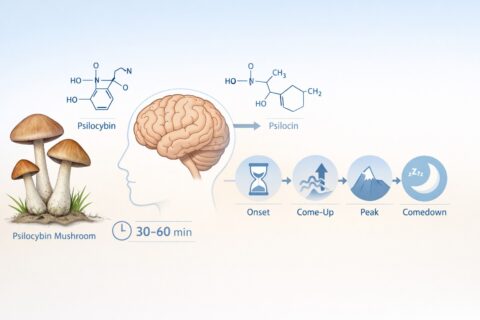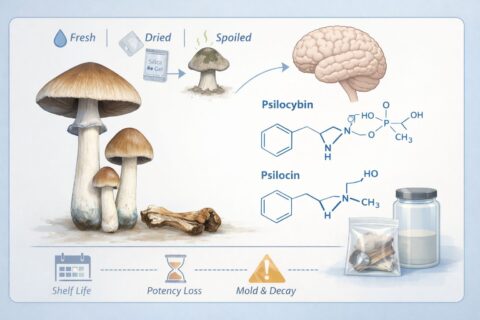
Microdosing is the practice of taking a very small amount of a psychedelic substance like psilocybin, the active compound in magic mushrooms. These small amounts are called “sub-perceptual” doses. That means they are low enough that you won’t feel high or experience hallucinations. The idea isn’t to trip or escape reality. Instead, people microdose in hopes of improving things like mood, focus, or creativity. Some even use it to help manage mental health symptoms like anxiety or depression.
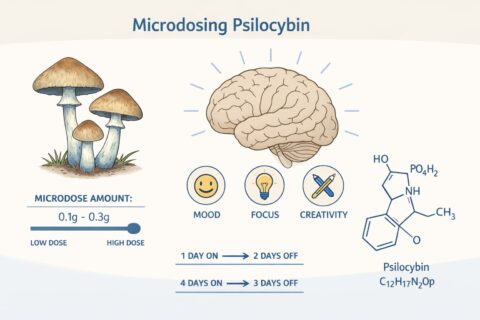
A typical microdose is about 5% to 10% of a full, recreational dose. For most people, that means taking between 0.1 grams and 0.3 grams (100 to 300 milligrams) of dried Psilocybe cubensis mushrooms. This is a common strain of magic mushroom.
If you start to feel high, dizzy, or notice visual effects like light bending or colours changing, the dose is too high. A true microdose should not make your day harder. You should be able to work, talk to people, and go about your day as usual.
There are a few common microdosing schedules that people follow. The goal is to keep the body from building up a tolerance while also being able to notice any changes over time. Below are four popular approaches:
Each person is different, and responses can vary. That’s why people are advised to start low, go slow, and keep track of how they feel.
The Stamets Stack is a popular method that adds other natural substances to the microdose to support brain health. It includes three parts:
The idea is that together, these three ingredients may help promote new neural pathways and improve long-term brain health. However, research is still developing in this area, and results are not guaranteed.
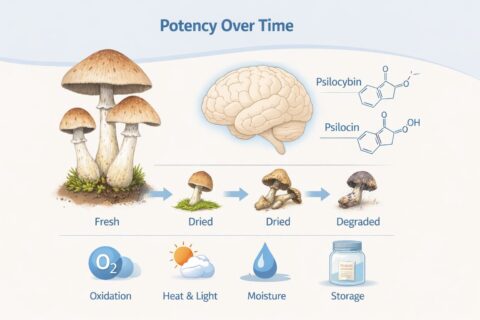
Because the potency of psilocybin can vary significantly even within a single batch, observers have noted that precision is a central focus for those exploring microdosing. In various community and research settings, several methods are frequently reported for attempting to achieve a consistent, sub-perceptual dose.
One of the primary challenges reported by users is the uneven distribution of psilocybin between different parts of the mushroom (such as the cap versus the stem). To address this, many individuals utilize a process of homogenization:
In documented reports, the use of precision tools is a recurring theme. Because a microdose is so small (often cited between 0.1g and 0.3g), standard kitchen scales are generally considered insufficient.
Some early studies and personal stories suggest that microdosing might offer several benefits. Keep in mind, though, that research is still ongoing, and much of the evidence so far is based on personal reports.
It’s important to note that these experiences aren’t the same for everyone. What helps one person might do nothing for someone else, or could even cause discomfort.
Yes, there are risks, especially for some people.
Again, while many report good results, it’s not risk-free, and it’s not for everyone.
The legal rules around magic mushrooms are complicated. In most parts of Canada and the United States, psilocybin is still illegal.
In Canada, psilocybin is considered a controlled substance under federal law. It’s not legal for everyday use. However, there are some exceptions for medical purposes. Through Canada’s Special Access Program (SAP), doctors can request permission for patients to try psilocybin when other treatments haven’t worked. These cases are rare and carefully reviewed.
In the U.S., psilocybin is still illegal at the federal level. It is a Schedule I drug, which means it is seen as having no accepted medical use and a high risk of misuse. However, some states are changing their rules. For example, Oregon and Colorado have started building legal frameworks for supervised therapeutic use. In some cities, like Denver, Seattle, and Detroit, personal possession has been decriminalized. That means it’s still technically illegal, but police are told not to make it a priority.
These changes don’t mean psilocybin is “legal” to buy or sell in stores. Selling or producing psilocybin products without approval remains illegal in both countries.
Microdosing magic mushrooms is a topic that’s growing in interest across Canada and beyond. While early stories and research show potential, it’s still an area that needs more study. If you’re curious, it’s important to understand the science, respect the risks, and know the legal limits. What works for one person may not work for another, and some people may experience unwanted side effects. As with anything that affects your mind or health, informed choices matter most.

© 2025 All rights Reserved.
Rocket Mushroom Shop

Are You 18 Or Over?
By clicking 'Continue', you confirm that you are over 18 years old. By using this website, you agree to our terms of service.